Purpose: To evaluate and understand the recent evidence on injury incidence and prevention in recreational tennis players. Aimed at recreational tennis players and those who treat them. Written by a Physiotherapist passionate about playing tennis and treating those competing.

Firstly, let’s consider the incidence of injuries in recreational tennis players.
Playing tennis places huge physiological stress throughout your whole body, unlike other popular sports such as football which places strain mainly on the lower limbs. The high and repetitive physical demands of tennis on a number of joints leads to overuse injuries. The most common injuries include knee, elbow and shoulder tendinopathies (61-80% of all tennis injuries) (Pluim et al 2016; Moreno-Pérez et al 2019) as well as lower back pain and other acute injuries.
Despite the physical demands of recreational tennis, previous evidence reports injury rates of only 0.04 to 3 per 1000 hours played (Pluim et al 2006). To investigate this further, Pas et al (2020) conducted a large-scale randomised control trial investigating injury prevention in tennis. This is the first piece of high quality research that studies the effects of an injury prevention programme in tennis.
The study identified unprecedented injury rates of 24-25 injuries per 1000 hours of recreational tennis played which is significantly more than was previously considered.
So why was this such a big difference to previous studies in tennis? This was likely due to varying criteria used to report an injury. The previous studies that reported lower injury rates only recorded an injury if it resulted in treatment in hospital or if it prevented play for more than 7 days. These injuries were therefore considered to be more severe. In the recent study, Pas et al recorded an injury if it scored 1 or more on the Modified Oslo Sports and Trauma Research Centre Questionnaire (Pluim et al 2016). This translates to any minor, moderate or severe injury reported.
As injuries had to be more severe to meet previous studies’ criteria, fewer injuries were reported. Pas et al identified that the majority of recreational tennis injuries are less severe, preventing play for an average 5-6 days. This confirms the majority of tennis injuries would not have been accounted for in previous studies, as injuries had to prevent play for more than 7 days to be reported.
Pas et al also found that 11-12% of all injuries recorded caused moderate or severe reductions in training, volume or performance, or a total inability to participate. This statistic correlates with the previous studies findings.
So, what does this evidence mean for you as a player?
- For a recreational tennis player (who plays just under 5 hours a week) on average you will pick up 1 minor injury every 9 weeks, preventing play for 5-6 days.
- For the same player, on average you will pick up 1 higher severity injury (preventing play more than 7 days) every year and 4 months, or longer.
With this knowledge, and with the considerable number of people who play tennis, surely there must be an evidence-based injury prevention programme?
In short, the answer is NO. In team sports, there is strong evidence to show that performing a frequent injury prevention programme reduced the number of injuries (FIFA 11+) (Vriend et al 2017). In tennis, however, the evidence isn’t there yet.
Despite warm up exercise programmes showing significant reduction in injury incidence in some team sports (Bizzini et al 2013), recreational tennis players don’t even warm up (Pas et al 2018)! So, in a sport that places so much repetitive physical stress on numerous joints, recreational tennis players ignore the fact that they will likely develop an overuse injury during the course of them playing! I’m sure this will change.
Within the study discussed above, Pas et al investigated the effectiveness of an app-based tennis specific injury prevention programme on adult recreational tennis players. The study compared a 12 week unsupervised app-based exercise programme to players current warm up and tennis practice. The exercise programme lasted 10 minute and was performed twice a week consisting of cardiovascular exercise, strengthening and tennis-specific exercise (see below).
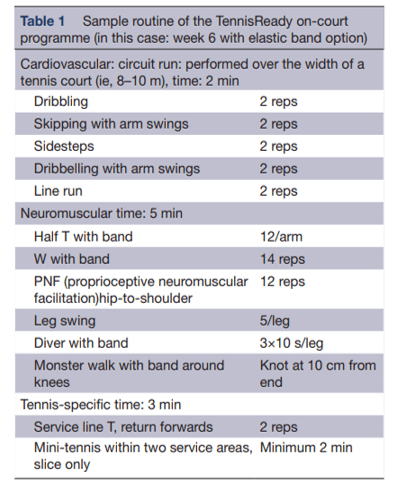
Pas et al found that an unsupervised exercise programme did not reduce the risk of tennis injuries. But why?
Unfortunately, adherence to each exercise on the programme was not monitored, and only 8% of participants reported high adherence to completing the study twice a week for 12 weeks. The fact that participants were not doing the exercise programme frequently could possibly explain the lack of benefit the exercise programme had to injury occurrence.
As a result, currently this unsupervised exercise programme is not recommended to reduce injury occurrence. As this study was the first high quality investigation into injury prevention in tennis, there currently is no evidence to support an injury prevention programme that works. It would be fascinating to examine the effect of a similar exercise programme which is supervised to ensure good adherence of participants.
In summary:
- The recent work of Pas et al (2020) confirms there are more injuries in recreational tennis players than previously considered.
- The majority of recreational tennis injuries prevent play for 5-6 days, with 11-12% of injuries causing moderate or severe reductions in play
- Currently, there is no evidence to support an injury prevention programme in tennis yet despite its clear demand.
References:
- Bizzini, M., Junge, A., & Dvorak, J. (2013). Implementation of the FIFA 11+ football warm up program: how to approach and convince the Football associations to invest in prevention. Br J Sports Med, 47(12), 803-806.
- Moreno-Pérez, V., Hernandez-Sanchez, S., Fernandez-Fernandez, J., Del, J., & Vera-Garcia, F. (2019). Incidence and conditions of musculoskeletal injuries in elite Spanish tennis academies: a prospective study. The Journal of sports medicine and physical fitness, 59(4), 655-665.
- Pas, H., Bodde, S., Kerkhoffs, G., Pluim, B., Tiemessen, I., Tol, J., & Gouttebarge, V. (2018). Systematic development of a tennis injury prevention programme. BMJ open sport & exercise medicine, 4(1), e000350.
- Pas, H., Pluim, B., Kilic, O., Verhagen, E., Gouttebarge, V., Holman, R., & Tol, J. (2020). Effectiveness of an e-health tennis-specific injury prevention programme: randomised controlled trial in adult recreational tennis players. British Journal of Sports Medicine.
- Pluim, B., Loeffen, F., Clarsen, B., Bahr, R., & Verhagen, E. (2016). A one‐season prospective study of injuries and illness in elite junior tennis. Scandinavian journal of medicine & science in sports, 26(5), 564-571.
- Vriend, I., Gouttebarge, V., Finch, C., Van Mechelen, W., & Verhagen, E. A. (2017). Intervention strategies used in sport injury prevention studies: a systematic review identifying studies applying the Haddon matrix. Sports medicine, 47(10), 2027-2043.
 Tennis Injury Prevention and Physiotherapy